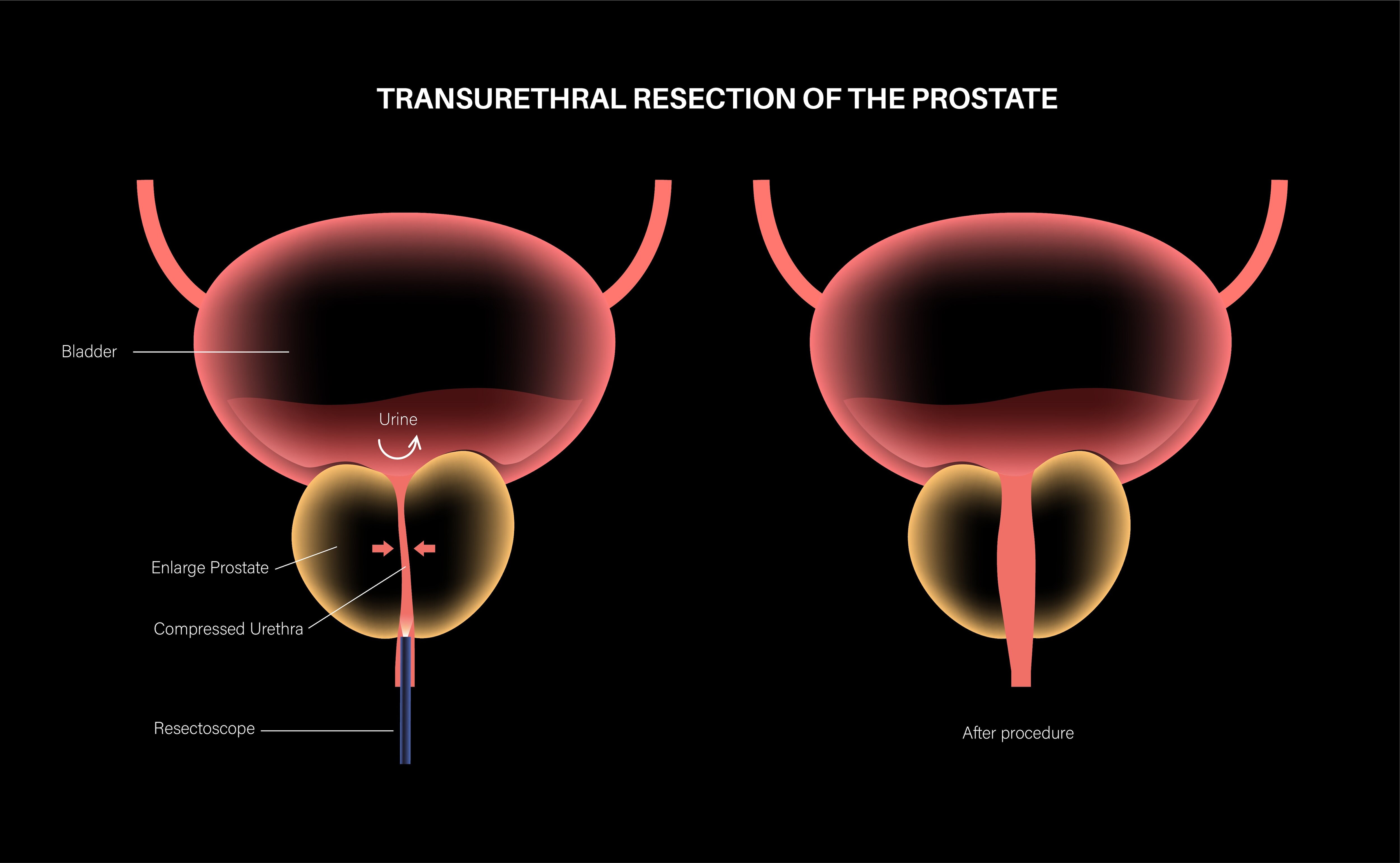
A weak stream, repeated night-time urination, or another urinary change does not automatically mean you need prostate surgery. By the end, you will know which symptoms and complications prompt a TURP discussion, how doctors confirm the cause, and how TURP compares with medication, laser procedures, and other options.
Key takeaways
- Discuss TURP when symptoms persist despite suitable medication.
- Confirm prostate obstruction before attributing urinary symptoms to an enlarged prostate.
- Consider surgery after retention, infections, kidney effects, or failed medication.
- Compare TURP with laser procedures, risks, recovery, and sexual side effects.
Which urinary problems make TURP worth discussing?
TURP is worth discussing when bothersome urinary symptoms persist despite suitable medication or conservative measures, or when you prefer a procedure after comparing alternatives. Typical symptoms include a weak urinary stream, interrupted urine flow, straining to urinate, prolonged urination duration, incomplete emptying, urgency, frequent night-time urination, and repeated urinary retention.
| Problem | Why it matters | What it suggests |
|---|---|---|
| Bothersome symptoms | Daily activities, sleep, or toilet access are affected | Discuss TURP after assessing obstruction and treatment response |
| Repeated acute urinary retention | The bladder repeatedly cannot empty | A complication that can make intervention more urgent |
| Recurrent infection or bladder stones | Stagnant urine creates further problems | Outlet obstruction may need treatment |
| Visible blood, kidney impairment, or upper-tract dilatation | Bleeding or pressure-related damage persists | Prompt evaluation and treatment of the obstruction |
Prostate size alone does not decide suitability. NICE recommends offering TURP for bothersome symptoms with an estimated prostate volume below 80 mL when medication has failed or is unsuitable; at 80 mL or above, clinicians consider HoLEP or simple prostatectomy instead. A large prostate can cause little obstruction, while a smaller one can block flow.
A high post-void residual does not prove TURP will help: weak bladder contraction can cause the same finding. TURP commonly improves flow and emptying, but urgency, frequency, or nocturia can remain when bladder dysfunction—not obstruction—causes them.
How do doctors confirm that prostate obstruction is the cause?
A high post-void residual (PVR) does not by itself prove that prostate obstruction is causing poor emptying. It can reflect a narrowed outlet, weak bladder contraction, or both, so clinicians compare the result with your symptoms, medical history, and examination.
Assessment commonly includes:
- Symptom review for weak or interrupted flow, straining, prolonged urination, urgency, nocturia, incomplete emptying, and retention.
- Medication review to identify drugs that worsen urinary symptoms, such as antihistamines, decongestants, opioids, or some antidepressants.
- A digital rectal examination to assess prostate size, consistency, and tenderness.
- Urinalysis for blood, glucose, and signs of infection; a urine culture when infection is suspected.
- A serum creatinine test to check kidney function when retention or obstruction could affect the upper urinary tract.
- Uroflowmetry and PVR measurement. A slow flow with a large residual supports obstruction, but does not confirm it.
- Prostate-specific antigen testing when a cancer assessment is clinically appropriate.
- Ultrasound or other imaging when clinicians need information about prostate size, bladder changes, stones, hydronephrosis, or residual urine.
- Cystoscopy when a urethral stricture, bladder abnormality, or another blockage is suspected.
- Pressure-flow urodynamic testing when weak bladder contraction and outlet obstruction cannot be separated, or when the result would change treatment.
These findings help distinguish benign prostatic obstruction from infection, medication effects, bladder dysfunction, urethral stricture, and prostate cancer. TURP treats obstructing benign tissue; it does not treat cancer.
When should medication give way to a procedure?
Medication gives way to a procedure when bothersome symptoms persist despite treatment, urinary retention keeps recurring, or obstruction causes complications. Tamsulosin, an alpha blocker, relaxes the prostate and bladder neck to improve flow; it works relatively quickly but does not shrink the prostate.
Finasteride, a 5-alpha-reductase inhibitor, gradually reduces prostate volume and lowers future retention risk when the gland is enlarged, but benefits take months.
- If acute urinary retention occurs, drain the bladder with a catheter and treat the immediate cause. Start an alpha blocker when appropriate, then attempt a trial without a catheter after several days. Measure the result rather than assuming success: inability to void, severe symptoms, or a large post-void residual urine supports further evaluation.
- If the trial fails, repeat retention occurs, or catheter removal remains impossible, assess obstruction alongside bladder muscle function. A high residual alone does not prove that TURP will help; weak bladder contraction can produce the same finding.
- Discuss TURP when symptoms remain unacceptable despite medication, or when obstruction leads to recurrent infections, bladder stones, persistent visible blood, kidney impairment, or upper-tract dilatation.
TURP is not mandatory simply because medication has been tried or the prostate is large. Confirmed obstruction and your treatment preference matter. Flow may improve after surgery, while urgency, frequency, or night-time urination can persist if bladder dysfunction also contributes.
How does TURP compare with laser surgery and other options?
The main trade-off is between reliable tissue removal and preserving ejaculation. TURP versus HoLEP is especially relevant when the prostate is large: conventional monopolar or bipolar TURP suits roughly 30–80 mL glands, while HoLEP and simple prostatectomy extend to larger glands.
| Option | Prostate size and durability | Bleeding, catheter, retreatment | Ejaculation and pathology |
|---|---|---|---|
| Monopolar TURP | Usually 30–80 mL; durable symptom relief | Moderate bleeding risk; catheter often 1–3 days; retreatment possible; dilutional hyponatraemia is a specific risk | Retrograde ejaculation is common; removed chips provide tissue for pathology |
| Bipolar TURP | Similar size range and durability to monopolar TURP | Similar catheter period; lower TUR syndrome risk, but bleeding and infection remain possible | Retrograde ejaculation is common; tissue is available for pathology |
| HoLEP laser prostate surgery | Suitable for small to very large glands; highly durable and low retreatment | Low bleeding risk; catheter often 1–2 days | Retrograde ejaculation is common; enucleated tissue is available for pathology |
| Photoselective vaporization | Useful for many small-to-moderate glands; retreatment can exceed enucleation | Low bleeding risk and short catheterisation | Ejaculation often changes; little or no tissue is available for pathology |
| Simple prostatectomy | Usually reserved for very large glands; durable | More invasive, with longer catheter and recovery | Retrograde ejaculation is common; substantial tissue is available |
| Prostatic urethral lift or water-vapour therapy | Best for selected smaller glands; higher retreatment risk | Usually brief catheter use and lower bleeding risk | Ejaculation is more often preserved; no tissue is available for pathology |
A surgeon also weighs prostate shape, anticoagulant use, equipment, and experience. TURP does not remove the whole prostate or rule out cancer; send any removed tissue for histopathology, and keep cancer assessment separate.
What should you clarify before consenting to TURP?
Consent should follow evidence that benign obstruction, not a urethral stricture, infection, medication effect, bladder dysfunction, or cancer, causes the problem. Ask whether prostate cancer assessment is complete and whether prostate size, flow testing, and residual urine support TURP.
TURP is not automatically first choice for retention. Catheter drainage and a trial without catheter, often with an alpha-blocker, may come first; recurrent retention or failed catheter removal makes surgery more relevant. Compare laser treatment, prostatic urethral lift, and water-vapour therapy if preserving ejaculation matters.
| Area | Clarify | Practical implication |
|---|---|---|
| Anaesthesia | General or spinal anaesthesia | Ask which is suitable for you |
| Catheter | How long the urinary catheter after TURP stays in place | Confirm removal timing and the trial without catheter |
| Expected result | Flow and emptying often improve; urgency, frequency, or nocturia may persist | Do not expect every symptom to disappear |
| Sexual function | Retrograde ejaculation is common | Erections and orgasmic sensation can remain possible |
| TURP risks | Bleeding, infection, temporary retention, stricture, bladder-neck contracture, and incontinence | Ask how each risk will be monitored and treated |
Take these questions to a urologist, including Dr. Vivek Jadhav Laser Stone and Urology Clinic:
- What result should TURP improve, and what symptom might need separate bladder treatment?
- How long will catheter care, bleeding, and activity restrictions last?
- What are my alternatives and their effects on ejaculation?
- Which warning signs after discharge require urgent review?
Related service
Complete endoscopic Prostate surgery with laser Complete endoscopic Prostate surgery with laser Complete endoscopic Prostate surgery with laser A complete endoscopic prostate surgery typically refers to a minimally invasive procedure known as... View service → |
Frequently asked questions
Which urinary problems make TURP worth discussing?
TURP is worth discussing for persistent bothersome symptoms such as weak or interrupted flow, straining, incomplete emptying, urgency, frequent night-time urination, or repeated urinary retention.
How do doctors confirm that prostate obstruction is the cause?
Doctors assess your history, examine the prostate, test urine, measure urinary flow and residual urine, and use additional tests when the diagnosis remains uncertain.
When should medication give way to a procedure?
A procedure becomes worth considering when suitable medication fails, urinary retention recurs, infections or bladder stones develop, kidney function is threatened, or symptoms remain unacceptable.
How does TURP compare with laser surgery and other options?
Your urologist compares TURP with laser enucleation, laser vaporisation, simple prostatectomy, and other treatments based on prostate size, symptoms, bleeding risk, recovery, and available expertise.
What should you clarify before consenting to TURP?
Ask about the diagnosis, expected benefit, bleeding and infection risks, catheter duration, hospital stay, recovery, retrograde ejaculation, erectile function, alternatives, and the chance of needing further treatment.